

ActiveCampaign for SaaS is a useful approach for teams that want better lifecycle messaging, smarter automation, and more relevant customer communication.
Affiliate disclosure: This article may contain affiliate links. If you purchase through these links, we may earn a commission at no additional cost to you.
Introduction
SaaS companies live and grow through customer relationships. It is not just about getting signups. It is about activating new users, guiding them toward value, reducing churn, and creating the right message for each stage of the customer journey.
That is where marketing automation can become much more than an email tool. For SaaS teams, a platform like ActiveCampaign can help connect lead capture, onboarding, product education, upsell campaigns, and customer retention into one system.
This article looks at how ActiveCampaign fits SaaS needs, what features matter most, where it works best, and how to avoid common mistakes when building a lifecycle marketing system.
Personal Insight
One thing that stands out with SaaS marketing is how quickly simple campaigns stop being enough. A welcome email and a newsletter may work early on, but growth usually creates more segments, more products, and more customer states to manage.
ActiveCampaign tends to be most useful when a SaaS business is ready to move from broad messaging to more behavior-based communication. The platform can do a lot, but the value comes from using it with a clear customer journey in mind.

What Is ActiveCampaign for SaaS?
For SaaS companies, ActiveCampaign is best understood as a customer communication and automation platform that helps teams manage the full lifecycle, from lead to trial user to paying customer and beyond.
Instead of sending the same campaigns to everyone, SaaS marketers can use it to tailor communication around actions and data points such as:
- Lead source
- Trial signup date
- Company size
- Product usage milestones
- Upgrade intent
- Subscription plan
- Renewal timing
- Engagement level
This matters because SaaS growth usually depends on timely and relevant messages. A new trial user needs very different communication than a long-term customer who has not used a feature in 30 days.
In practical terms, ActiveCampaign helps SaaS teams automate those transitions without relying on manual follow-up for every step.
Key Features That Matter Most for SaaS Teams
Automation workflows
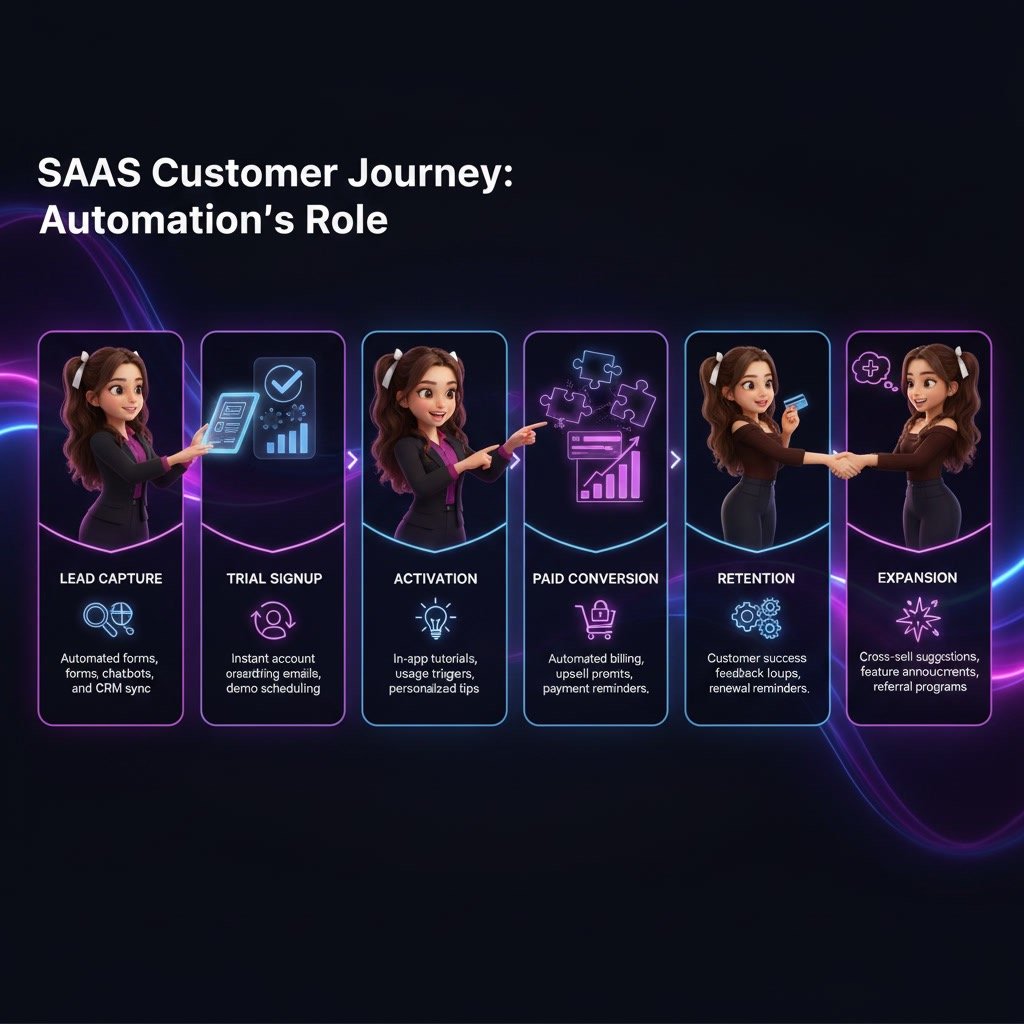
Automation is the main reason many SaaS businesses look at ActiveCampaign. Teams can build workflows triggered by signups, email engagement, form fills, deal updates, tags, custom events, or other data points.
For SaaS, that can support:
- Trial welcome sequences
- Onboarding education emails
- Feature adoption nudges
- Upgrade prompts
- Renewal reminders
- Win-back campaigns for inactive users
The real benefit is consistency. Every user can receive a structured journey based on what they actually do, not just when a marketer remembers to send a campaign.
Segmentation and tagging
SaaS audiences are rarely one group. You may have founders, agencies, enterprise buyers, product-led growth users, free trial users, and existing customers all in the same database.
ActiveCampaign makes it easier to segment based on firmographic data, plan type, activity, source, or engagement. This allows more accurate campaigns and helps prevent irrelevant messages from reaching the wrong people.
Custom fields and event-based personalization
SaaS teams often need more than name and email address. They may want to track plan type, product tier, account status, renewal date, seats used, or onboarding progress.
With custom fields and connected product data, campaigns can reflect real customer context. That makes emails feel more useful and more timely, especially during onboarding and retention campaigns.
CRM and sales alignment
Not every SaaS company uses a sales-led model, but many have at least some handoff between marketing, sales, and customer success. ActiveCampaign includes CRM capabilities that can help manage those transitions.
This can be valuable for:
- High-intent demo requests
- Qualified product signups
- Enterprise outreach
- Expansion opportunities
- Renewal follow-up
For hybrid SaaS models, having automation and pipeline activity close together can improve response speed and visibility.
Lead scoring
Lead scoring can help SaaS teams identify who is most likely to convert. For example, a lead who visits pricing, attends a webinar, and starts a trial may deserve faster follow-up than someone who only downloaded one resource.
This is especially useful for sales-assisted SaaS businesses that need to prioritize limited time and outreach.
Email creation and testing
Strong lifecycle marketing still depends on solid email execution. ActiveCampaign supports campaign building, testing, and performance tracking, which gives SaaS marketers room to improve subject lines, timing, and message structure over time.
Testing matters because a small improvement in activation or retention messaging can create meaningful revenue impact for subscription businesses.
Use Cases for SaaS Companies
Trial onboarding
This is one of the most natural use cases. A new trial user usually needs help reaching first value quickly. An onboarding sequence can introduce key steps, explain core features, and encourage the actions most tied to conversion.
For example, a workflow might send:
- A welcome email immediately after signup
- A setup guide on day one
- A feature tutorial after first login
- A case study for users who have not activated
- An upgrade message near trial end
Product education
Many SaaS products have useful features that users never discover on their own. ActiveCampaign can support educational sequences based on role, use case, or stage of adoption.
Instead of sending one generic newsletter, teams can deliver focused content that helps customers get more value from the product.
Lead nurturing before signup
Some SaaS buyers convert quickly, but others need more time. Automated lead nurturing can help move prospects from awareness to demo request or trial signup through targeted content and progressive engagement.
This is especially helpful for B2B SaaS with longer evaluation cycles.
Upgrade and expansion campaigns
Existing customers are often the best growth channel for SaaS businesses. Teams can build campaigns based on usage, account maturity, feature demand, or plan limits to encourage expansion at the right time.
These campaigns work best when they are based on clear product signals rather than broad assumptions.
Churn prevention and win-back
Retention is where lifecycle automation becomes highly valuable. If usage drops, support activity increases, or engagement fades, automation can trigger helpful messaging before churn happens.
That might include training content, check-in prompts, feature reminders, or account review invitations. For churned users, win-back campaigns can reintroduce product value, highlight updates, or offer a reason to return.

Best Practices for Getting Better Results
Map the customer journey first
Before building automations, identify the major stages of your SaaS journey. Most teams need at least a rough map covering lead capture, trial, activation, conversion, onboarding, retention, expansion, and re-engagement.
Without that structure, automation can become a collection of disconnected campaigns.
Start with a few high-impact workflows
It is better to launch three useful automations than fifteen incomplete ones. For many SaaS teams, the most important early workflows are:
- Lead nurture
- Trial onboarding
- Inactive user re-engagement
Once those are performing well, more advanced journeys can be added.
Use product data carefully
The quality of SaaS automation improves when campaigns reflect actual behavior. If possible, connect data such as logins, feature usage, trial status, and plan level. This helps avoid sending generic messages that ignore what the user already did.
At the same time, do not overload campaigns with every possible trigger. Use the signals that genuinely matter.
Keep messaging simple and timely
SaaS emails often perform best when they are direct and useful. Focus on one action, one insight, or one next step per message. Clear onboarding and support-oriented language usually outperform complicated messaging.
Review automation performance regularly
Even strong workflows need maintenance. Product changes, new pricing, revised onboarding steps, and audience shifts can all make an older sequence less effective.
Set a review rhythm for open rates, click rates, conversion rates, reply rates, and downstream metrics such as activation or upgrade rate.
Common Mistakes SaaS Teams Should Avoid
Building automation without a strategy
It is easy to create workflows just because the platform allows it. But if each automation is not tied to a business goal, complexity grows faster than value.
Every sequence should answer a simple question: what customer outcome is this trying to improve?
Sending the same messaging to every user
SaaS users have different plans, goals, and levels of maturity. If trial users, active customers, and at-risk accounts receive identical messages, engagement often falls. Segmentation is not optional once a SaaS business starts growing.
Ignoring onboarding after the first email
Many teams send a welcome email and assume the user will figure out the rest. In reality, activation often needs a series of nudges, education, and reminders. Good onboarding is a process, not a single message.
Using too many tags or fields without governance
Data structure matters. If your account ends up with duplicate tags, outdated fields, and unclear naming conventions, reporting and automation logic become harder to trust. Keep your setup clean and documented.
Measuring only email metrics
Open and click rates are useful, but SaaS teams should look beyond them. A campaign is successful when it helps users activate, convert, retain, or expand. Tie messaging back to product and revenue outcomes whenever possible.
FAQ
Is ActiveCampaign a good fit for SaaS companies?
Yes, especially for SaaS businesses that need lifecycle automation, segmentation, and personalized customer communication. It is often a stronger fit once the company has enough user stages and behaviors to justify more advanced workflows.
Can ActiveCampaign support trial onboarding?
Yes. Trial onboarding is one of the most practical use cases. Teams can automate welcome messages, setup guidance, education, reminders, and upgrade prompts based on timing or behavior.
Does ActiveCampaign work for product-led growth SaaS?
It can, provided the team has a clear way to pass product data into the system. Product-led growth depends heavily on behavior-based messaging, so data quality and event tracking are important.
Is ActiveCampaign only for email marketing?
No. Email is central, but the platform is broader than a basic newsletter tool. It supports automation, segmentation, CRM workflows, lead scoring, and customer journey management.
What type of SaaS business benefits most from ActiveCampaign?
It is often most helpful for growing SaaS teams that have moved beyond simple batch email and now need onboarding flows, behavioral targeting, lead nurturing, or retention campaigns. Smaller early-stage teams can still use it, but the strongest value usually appears when lifecycle complexity increases.
Final Verdict
ActiveCampaign can be a strong choice for SaaS teams that want to build a smarter lifecycle marketing system instead of relying on one-off campaigns. Its value shows up most clearly in onboarding, segmentation, product education, retention, and expansion workflows.
It is a better fit for teams willing to map their customer journey, organize their data, and improve automations over time. If your SaaS business is ready for more targeted communication and more structured growth systems, ActiveCampaign is well worth serious consideration.
Recommended Guides
- Activecampaign Pricing Explained
- Activecampaign Alternatives
- Is Activecampaign Worth It
- ActiveCampaign Segmentation Guide: How to Target the Right Audience (2026)
- Activecampaign Campaign Builder Guide
- Activecampaign Integration Guide
- ActiveCampaign Email Delivery Tips: Improve Deliverability
- ActiveCampaign Automation Examples: Real Workflows Explained
- Activecampaign Login Not Working
- Activecampaign Contacts Not Syncing
- Activecampaign Campaign Not Sending
- Activecampaign Ultimate Guide