

If you are comparing ActiveCampaign vs MailChimp, the real difference comes down to how much automation, flexibility, and simplicity your business actually needs.
Choosing between these two platforms can feel harder than it should be because both are well-known, widely used, and capable of handling email marketing for growing businesses. On the surface, they overlap in many areas, but once you look closer, they serve different types of users.
One platform tends to appeal more to people who want deeper automation and customer journey control. The other often feels more approachable for users who want a faster setup, a familiar interface, and a straightforward way to create campaigns.
Affiliate disclosure: This article may contain affiliate links. If you purchase through these links, we may earn a commission at no additional cost to you.
Introduction
ActiveCampaign and Mailchimp are both popular email marketing tools, but they are not built with the exact same priorities. That matters because the right platform depends less on brand recognition and more on how you plan to manage your audience, your campaigns, and your long-term marketing workflow.
For some businesses, the deciding factor is automation depth. For others, it is ease of use, design flexibility, reporting, or how naturally the tool fits into an existing stack. A small creator sending weekly newsletters may value simplicity, while a sales-driven business may need advanced segmentation and behavior-based follow-up.
This guide breaks down the major differences in a practical way. Instead of treating the comparison like a winner-takes-all contest, the goal is to help you understand where each platform stands out and which type of user is likely to get the best results from each one.
Personal Insight
When people compare these tools, they often focus only on price or templates, but that usually misses the bigger picture. In my experience, the better question is how much control you want over your customer journey and whether you need a platform that grows with more advanced marketing later on.
Many users start with a simple email need and then discover they want stronger segmentation, smarter automations, or better sales alignment. That is often where the difference between these platforms becomes much more noticeable.

What Is the Topic
Why this comparison matters
At a basic level, both ActiveCampaign and Mailchimp help businesses collect contacts, send email campaigns, build automations, and track performance. But comparing them matters because they approach those tasks differently.
Mailchimp is often seen as easier to get started with, especially for users who prioritize basic campaigns, attractive templates, and a familiar workflow. ActiveCampaign is commonly chosen by teams that want more advanced automations, stronger customer segmentation, and more direct connections between email marketing and broader customer relationship management.
How to think about the choice
The smartest way to compare these tools is to think in terms of business model and workflow complexity. If your strategy centers on newsletters, announcements, and occasional promotions, a simpler platform may be enough. If your strategy depends on lifecycle marketing, lead nurturing, behavior-based messaging, and targeted follow-up, the more advanced option usually creates more room to grow.
That does not automatically make one better than the other. It simply means each platform has a more natural audience fit.
Key Features
Automation depth
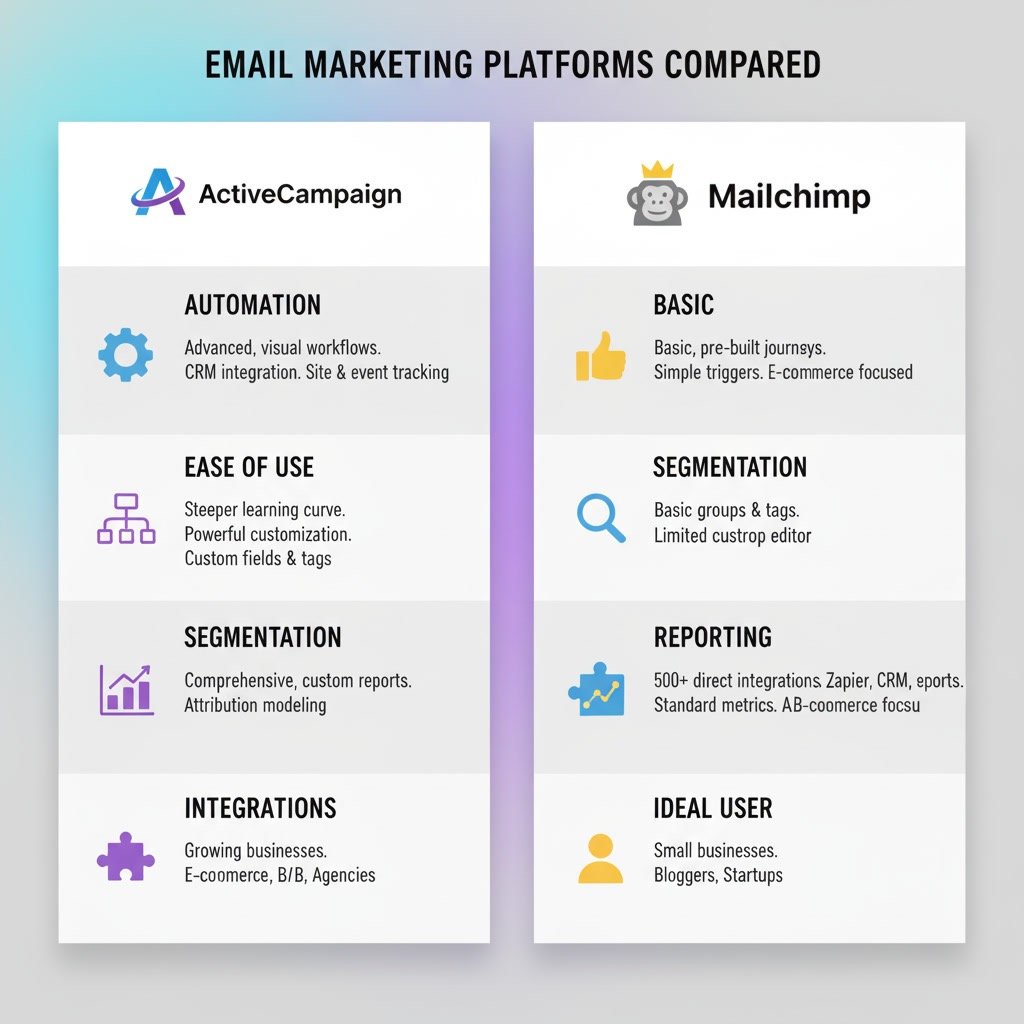
This is where ActiveCampaign often separates itself. It is built with automation as a core strength, not just an added feature. Users can create detailed workflows based on subscriber behavior, timing, tags, site activity, goals, and other triggers.
Mailchimp offers automation too, but for many users it feels more limited or more centered on simpler customer journeys. That may be enough if your workflow is straightforward, such as a welcome sequence, abandoned cart email, or basic follow-up series. But if you want layered logic and more tailored messaging paths, ActiveCampaign usually offers more flexibility.
Ease of use
Mailchimp often feels more beginner-friendly at the start. Its interface is generally designed to help users move quickly through common tasks like creating a campaign, choosing a template, importing contacts, and reviewing reports. That simplicity can reduce setup friction for smaller teams.
ActiveCampaign is usable, but it often comes with a steeper learning curve because it offers more moving parts. That extra depth is helpful for advanced users, but it may feel more demanding for those who want a basic setup with minimal configuration.
Segmentation and targeting
Segmentation is one of the most important differences in practice. ActiveCampaign is generally stronger when you want to group contacts based on behavior, engagement, funnel stage, tags, actions, or custom data points. This makes it easier to send more relevant campaigns to the right audience at the right time.
Mailchimp supports audience targeting, but businesses with more complex segmentation needs may find it less flexible over time. If your list strategy is simple, that may not matter. If relevance and personalization are central to your growth strategy, it matters a lot.
Campaign builder and design experience
Mailchimp has long been associated with accessible campaign design. Many users like its templates, visual editing tools, and relatively quick campaign setup. For creators, small teams, and businesses that send polished visual newsletters, this can be a real advantage.
ActiveCampaign also includes campaign-building tools, but it tends to be valued more for workflow power than for template-first simplicity. If your priority is elegant design with light complexity, Mailchimp may feel smoother. If your priority is what happens before and after the email is sent, ActiveCampaign usually has the edge.
CRM and sales alignment
ActiveCampaign is often a stronger fit for businesses that want email marketing connected more closely to sales processes. Its CRM-oriented capabilities help teams manage lead movement, automate follow-up, and create more connected customer journeys.
Mailchimp can support sales-related use cases, but it is generally not chosen first for teams looking for deeper sales automation or pipeline management. Service businesses, B2B teams, and lead-driven companies often notice this difference early.
Reporting and optimization
Both tools provide campaign reporting, including common metrics like opens, clicks, and engagement. The difference often comes down to how much context you want around user behavior and how you plan to act on the data.
For simple campaign review, either platform may work well. For users who want reporting connected more directly to automations, lifecycle steps, and conversion behavior, ActiveCampaign can offer more depth.
Integrations and ecosystem
Both platforms connect with a wide range of tools, including ecommerce systems, forms, websites, and third-party apps. Mailchimp works well for many standard marketing setups. ActiveCampaign is also integration-friendly, especially for businesses building more connected workflows across marketing and sales.
In most cases, integrations alone will not decide the comparison, but they can matter if you rely on a specific stack or want to automate data flow between systems.

Use Cases
Who should choose Mailchimp
Mailchimp is often a strong fit for creators, small businesses, local brands, and teams that want to get campaigns out quickly without spending much time building advanced systems. It works well for newsletters, product updates, promotional sends, and basic lifecycle email.
It can also be a sensible option for users who value ease of use more than workflow depth. If your email strategy is mostly about consistent communication rather than highly personalized journeys, Mailchimp may be enough.
Who should choose ActiveCampaign
ActiveCampaign is often better suited for businesses that need more precise targeting and stronger automation. This includes ecommerce brands with segmented journeys, service businesses that nurture leads over time, B2B teams that want closer marketing and sales coordination, and growing companies that want their email setup to become more sophisticated.
If your strategy depends on sending different messages based on subscriber behavior, funnel stage, or engagement level, ActiveCampaign is usually the more capable choice.
Best fit by business stage
Early-stage businesses often lean toward simpler tools because speed matters. As systems mature, list sizes grow, and audience segments become more important, the value of advanced automation becomes clearer.
That is why some businesses start with Mailchimp and later move to ActiveCampaign. Others stay with Mailchimp long-term because their needs remain clear and uncomplicated. The better fit depends on whether complexity is a burden for you or a useful advantage.
Best Practices
Match the tool to your actual workflow
Do not choose based only on what the platform could do one day. Choose based on what your team will realistically use in the next 6 to 12 months. A simpler tool that gets used well can outperform a more advanced platform that is only partially adopted.
Plan your audience structure early
Before migrating or setting up either platform, define how you want to organize contacts. Think about tags, segments, lifecycle stages, and campaign goals. A clean structure makes future automation and reporting much easier.
Test automation before scaling it
If you use ActiveCampaign, automation power is only useful when workflows are tested carefully. Make sure triggers, delays, conditions, and follow-up actions behave as expected before adding more complexity.
Keep campaign goals clear
Whether you use Mailchimp or ActiveCampaign, every campaign should have a clear purpose. Are you trying to inform, convert, re-engage, onboard, or educate? Clear goals make platform differences easier to evaluate and results easier to improve.
Review engagement regularly
A strong email strategy is not just about sending more. It is about learning what your audience responds to. Review opens, clicks, conversions, unsubscribes, and segment performance on a regular basis so your list stays healthy and your messaging stays relevant.
Common Mistakes
Choosing based only on popularity
Both brands are well known, but popularity does not guarantee fit. Many users choose a platform because they have heard of it, not because it matches their marketing process.
Overlooking future complexity
Some businesses choose the easiest option without thinking about what they will need as their audience grows. If you expect more segmentation, longer customer journeys, or sales alignment, it is worth planning ahead.
Paying for features you will not use
The opposite mistake is choosing a powerful platform while using only a small portion of its capabilities. If your needs are simple and likely to stay that way, you may not benefit from extra complexity.
Ignoring migration effort
Switching platforms is not just about moving contacts. You may need to rebuild forms, automations, tags, templates, and reporting workflows. That effort should be part of your decision.
Assuming design matters more than strategy
A nice-looking email helps, but relevance, timing, and segmentation usually have a bigger impact on results. It is easy to focus on templates while overlooking customer journey quality.
FAQ
Is ActiveCampaign better than Mailchimp?
It depends on your needs. ActiveCampaign is often better for advanced automation, segmentation, and sales-connected workflows. Mailchimp is often better for simpler email marketing and faster setup.
Is Mailchimp easier to use than ActiveCampaign?
For many beginners, yes. Mailchimp usually feels more approachable for basic campaigns and template-based email creation. ActiveCampaign offers more power, but that can come with a steeper learning curve.
Which platform is better for automation?
ActiveCampaign is generally stronger for automation. It gives users more flexibility for building detailed workflows based on behavior, conditions, and lifecycle logic.
Which one is better for small businesses?
Both can work for small businesses. Mailchimp is often a good fit for straightforward newsletter and promotion workflows. ActiveCampaign is often better for small businesses that rely on lead nurturing, targeted follow-up, or more advanced segmentation.
Can you switch from Mailchimp to ActiveCampaign later?
Yes, many businesses do. However, it is important to plan the migration carefully so contacts, tags, forms, and automations transfer in a structured way.
Which platform is better for ecommerce?
It depends on how advanced your customer journey is. Mailchimp can work well for basic ecommerce email needs. ActiveCampaign is often stronger for more detailed post-purchase flows, audience segmentation, and behavior-driven campaigns.
Final Verdict
There is no single winner for every business. Mailchimp is often the better choice for users who want a clean, familiar email marketing platform for newsletters, promotions, and simple automations without much setup friction.
ActiveCampaign is usually the better fit for businesses that want deeper automation, more precise segmentation, and a platform that supports more advanced lifecycle marketing as they grow. If your email strategy is becoming more targeted, personalized, and workflow-driven, ActiveCampaign will likely feel more aligned with your long-term needs.
Affiliate disclosure: This article may contain affiliate links. If you purchase through these links, we may earn a commission at no additional cost to you.
Recommended Guides
- Activecampaign Pricing Explained
- Activecampaign Alternatives
- Is Activecampaign Worth It
- ActiveCampaign Segmentation Guide: How to Target the Right Audience (2026)
- Activecampaign Campaign Builder Guide
- Activecampaign Integration Guide
- ActiveCampaign Email Delivery Tips: Improve Deliverability
- ActiveCampaign Automation Examples: Real Workflows Explained
- Activecampaign Login Not Working
- Activecampaign Contacts Not Syncing
- Activecampaign Campaign Not Sending
- Activecampaign Ultimate Guide